
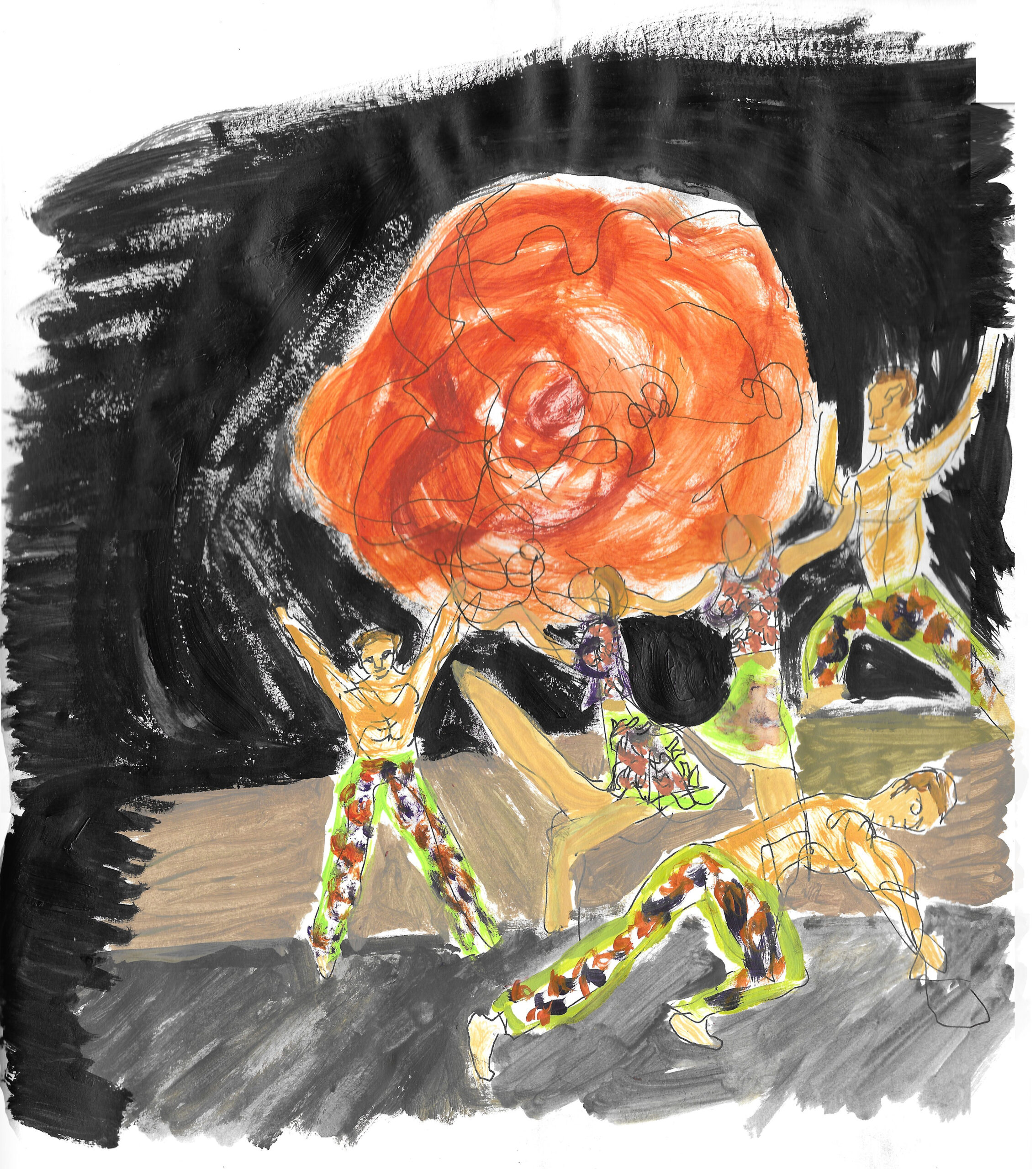
Paul Taylor Dance Company brought me to his autobiography, Private Domain. Bridging theater and dance on stage to critique with live sketches to support the art criticism. The objective was to critique a diversity of artists from a critical point of view. With each artist on stage came a sentimental bearing on the everyday gestures, which grounded audiences in the nature of what they saw. It quickly became a study of movement. In fact, that motion before making a scene was most important to capture. By actively drawing into the action, and creating anticipation was about being involved in the movement. This is configuration of live performances weighs heavily on my critical analysis.

2018
Fringearts Presents
Jaamil Olawale Kosoko
Séance


2018
Fringearts Presents
THE ACCOUNTANT
Trey Lyford


MEDIA MUSICAL THEATER
2017
Beauty and The Beast
In a town somewhere far away there is an enchanted castle. Belle and the Beast coexist and move us, instinctually, by the magic and mystery. Belle finds herself a prisoner, but is treated like a guest in the castle. The enchanted castle changes her attitude toward the Beast. She is faced with a cold animalized person, and the connection to the lively townsfolk is a mirroring of beastly appearances. Babette and Lumiere, played by Julianna Babb and JP Dunphy, are only half-human (one was part broom, the other part candlestick). But they notice the beauty in Belle. Cogsworth, played by Kelly Briggs, mentions that they are slowly losing their minds because of the curse. The placement of characters opposed to one another in the musical are separated by a distant relative almost incestuous. That is, the distance between man and beast is very ambiguous.

Belle walked in on Lumiere and Babette fooling around as the ensemble kicked, cartwheeled, and sang, “Be Our Guest.” This was a fancy way of saying, let us be human again and treat others like other human beings. Alan Menken, Howard Ashman, and Time Rice write the music that adapts a fairytale into a serious look at humanity, when the household objects show gratitude for Belle’s company. The consciousness in these songs unwound a material obsession, and a society possessed by beauty. The rapture in “Human Again” reconsiders the beauty in Gaston, The Beast, Le fou, or even Maurice. At last, we are more than just household appliances. Belle’s imaginary world was built on books and listening to her dreams, a 19th century realism I know fondly by Gustave Flaubert’s Madame Bovary, and Lady Chatterley’s Lover by D.H Lawrence. This made Belle an outcast like the Beast. No sympathy for the townsfolk, ladies in waiting, or the brut tells us something about our own society. There was a ring around the rose, and the cursed chest of drawers, played by Moly Tower, turned to the audience and began singing. It was expressionistic, and there was no comparison to right or wrong.

Tania El Khoury
Gardens Speak

How much do we know about the ongoing massacres of the civil war in Syria? How much do we comprehend about the tragedies of more than five million refugees and innumerable martyrs – or “shuhada” – in this blood-fueled fight?

In Gardens Speak, Tania El Khoury takes a different approach to intervention, setting aside graphic visuals we may encounter in the media. The installation is an auditory and sensory encounter with tragedy in its rawest form. El Khoury rejects the traditional channels that have failed to speak for Syrian communities. Instead, she hands over the narrative to the voices beneath the ground – to those who took their stories to the grave.
A Doll House 2 by Lucas Hnath


In 2018, I had the opportunity to draw during rehearsals for Lucas Hnath’s new play, A Doll House Part Two. By then I have had been training, and my eye was beginning to see the schism of themes play with literary techniques. For instance, I knew a Henrik Isbn play, Lady By the Sea, compared to The Enchanted by Jean Anouhilh. The classics informed the contemporary, and they were saying the same things in their own circumstances. The Tale of Two Cities, Jane Eyre, The Turn of The Screw, Iphigenia in Aulis, Faust, A Doll House, The Seagull. This was the philosophy, in drama are formulas on being, and Katherine Weber’s philosophy showed me what that means to a society.

An investigation of performing arts for the 2018 season showed theater and dance illuminate each category of artist. Next Move Dance a series at The Prince Theater welcomed press for Phindie author, Chuck Schultz to sketch throughout the 17/18 season, “The Season of WOW!” And in 2021, I would design a visual review of Dorrance Dance at Penn Arts Live. Depicting Michelle Dorrance and company in Ella’quent Holiday Swing, featuring Aaron Marcellus on vocals. The graphic artist and the dance artists combined for the first time for a final critique.
NextMove Dance
The influence of Dance at this time tied in many themes of different cultures, in a continued investigation of diverse performance styles.
Hervé Koubi
October 2017
Blend of Arabic and French dance influences explored aerobatic and street performing styles. The Algerian choreographer explains an autoethnogaphic search into his family history
Ronald K Brown/ Evidence
December 2017
Hip-hop, African and Caribbean movement philosophies in the spirit of high energy and gospel spirituals.
Jessica Lang Dance Company
December 2017
Hip-hop, African and Caribbean movement philosophies in the spirit of high energy and gospel spirituals.
BodyVox
January 2018
Urban Meadow


Hervé Koubi, What The Day Owes To The Night, 2017.

When NextMove Dance introduced the choreographers of different dance companies they left an impression on the way we think about the creation of dance. Beginning with where, or what influenced their style of dance, and how they create as artists, and what we should expect from their work.


Jessica Lang Dance
Jessica Lang Dance was from Philadelphia, and this was exciting because to see a company native to the city and return to the Dance Affiliate, a series of international headlines. In 2017, Jessica Lang Dance came through side-by-side with larger companies, Paul Taylor Dance Company, Doug Varone and Dancers, Trocadaro, Martha Graham Dance.


Her Road (Georgia O’Keeffe Trilogy)


BodyVox


An emphasis on drawing new forms, and observations in the theater. During this time, from 2016-2018 I was a liberal arts student at the University of Pennsylvania. The impact of live performances and my liberal arts studies took me across many disciplines & genres.
The creative community welcomed this curiosity for a critical analysis. I was interested in the collectivity among theaters, dancers, and public programing across the city. In this context, EgoPo Classic Theater and a partnership with Cape town, South Africa brought an interesting theme to politics at this time when the election in 2016 ushered in a new kind of politician vs activism for theater artists. Abrahamse & Meyer’s adaptation of Eugene Oneill’s “Desire Under The Elm” was in response to Apartheid in South Africa 1990’s. It was important to understand the context in reaction to politics.

Desire Under The Elm by Eugene O’neill
More from EgoPo Classic Theater…
A Human Being Died That Night by Pumla Gobodo-Madikizela, adaptation by Nicholas Wright, directed by Steven Wright.


Censored: “Master Harold”…and the Boys by Athol Fugard, directed by Lane Savadove

There is simplicity to which words cannot explain. Thoughts, difficult to explain, and troubling subject matter on stage for audiences to decipher. Some controversial artists here show a field of classical design which helps inform audiences. Classical titles in archival scripts lend themselves to the contemporary moment. New choreography for modern dance portrays a new lens for design and costume, as well as technology for projection art and lighting design. Intersections of artistic disciplines are interactive in ways that under circumstances politically or mundanely, reimagine our footing of what contemporary art means for A Critical Analysis.

