
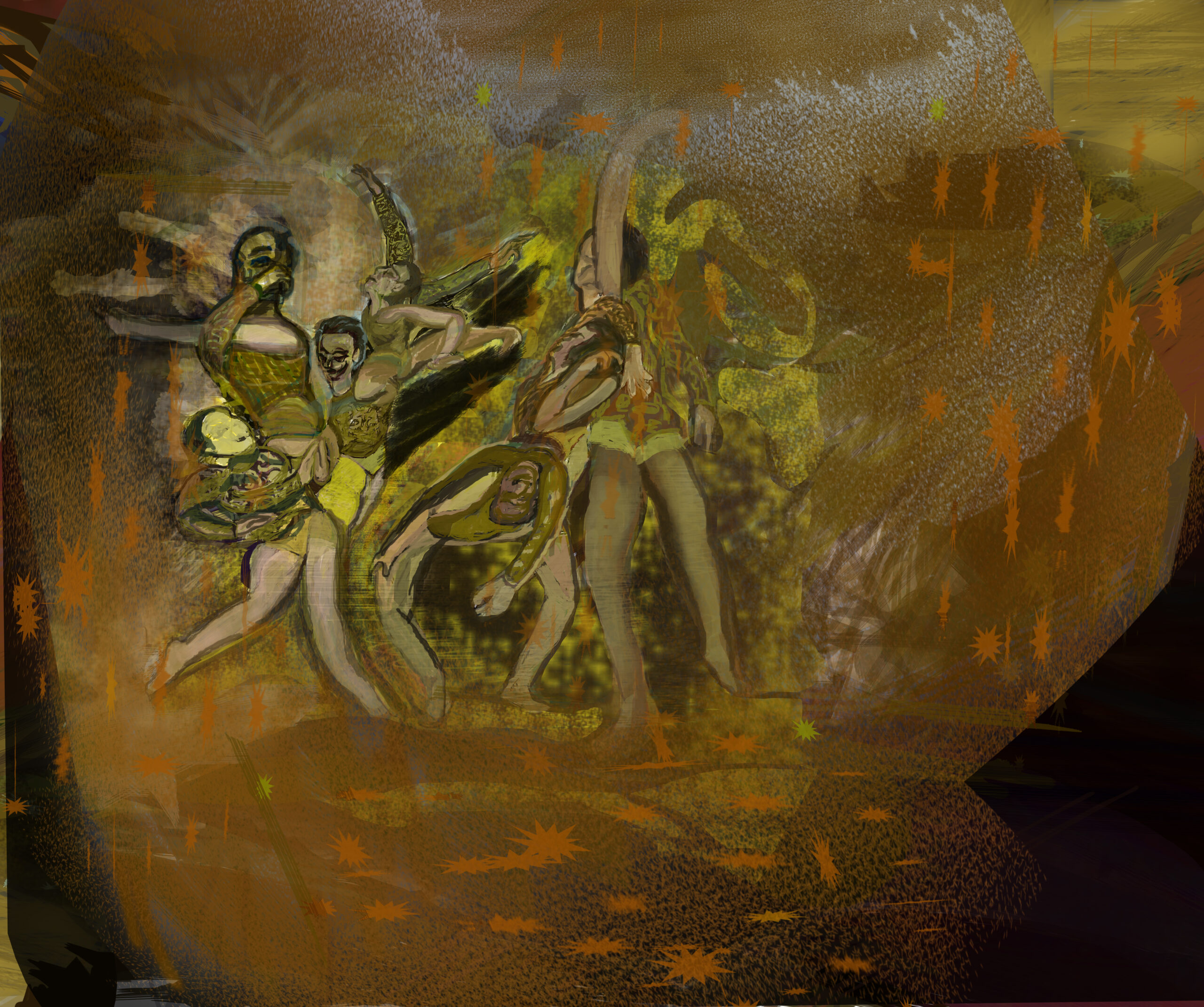
A graphic design in motion. Figurative art depicting the body in space. I turned to this artistic medium to move more quickly. Reflecting on the rhythms & technology in social media. It shows how the art form takes shape on social platforms. The dance artists’ vision passes before photographic images, naturally upon the lens. A perspective change with every choice. Choreography itself is another realm I turn a new page in defining the theater in movement on stage. Line drawings from a performative documentation of the event is the Graphic Critique.

Under the Black Moon,
total darkness escapes us,
rock dust space leggings.
Turning my thoughts to the evolution of modern ballet in a showcase of contemporary choreography with the New York City Ballet. I found modern ballet by George Balanchine was alluring for its continuum of classical nuances entering in our modernity with movement.

My review of the New York City Ballet with Kyle Abraham’s “When We Fell” took on two parts. It was a contemporary dance program that made the jump from the classics of George Balanchine to Alexei Ratmansky in two segments. Originally, this film to stage, “When We Fell” entailed an adaptation so unexpected for the medium that its black and white film in 2021 for a refurbished version with a live audience in 2025 meant perfectly well, to transmit technique adopted by these modern choreographers from their predecessors.

CHIAROSCURO by Lynne-Taylor Corbett placed a significance on this singular moment, for a woman choreographer to show the feminine gaze. It captured the other, specifically sensible to a ghostly appearance. A presence on stage, defining a renaissance, and the desire for something indefinite through history. The technique of chiaroscuro explored through light and darkness. Tonal elements of time and space represented then and there, in the values that became meaningful and felt lost. The richness of candle lit scenes, and the deepest darkest emotions, were translated figuratively by the vanishing perspective in the dance.
Eclectic
NYCBallet
Spring 2025

George Balanchine – Kyle Abraham
In a search for meaning, When We Fell, took the stage just before our first intermission. The characters replaced fairies in love for being reflective of ones-self in a state of being. The first thought, what physicality, self-interested as the fallen man. Following an adaption of medium to this final sense of nature, glorified before the human body. And this calculated test of beauty in the whole evolution of the extension of our body and intellect. Moving from the black and white film with an empty concert hall, in the grandiose lobby of the David H. Koch Theater, and its first glance of Paradise Lost. Now, revived for a technicolored- orange glow from the dancers in its adaption to the live performance.
Divertimento, Le Baiser de la Fée by George Balanchine felt ironically, sarcastic; a growing light was inviting with open arms. In its corps, and the duet it created possibilities of poetry, and its creatures symbolized our fantasy. An ideal, where even with goodness there becomes darkness.
Lynne Taylor-Corbett – Alexei Ratmansky
A silly beginning, from Le Baiser de la Fée, Divertimento felt this warm feeling transform amusement to shape the choreography we saw throughout the modern ballet- ECLECTIC New York City Ballet.
In the first half, it is as if the warmth begins to burn us at the transition from Balanchine to Abraham’s When We Fell. The tone changed with the second part, to a post-classical focus in angst- this alteration to sum it up: the soft light sculpted for the Renaissance artists, only to resolve in revolutionary times with bright lights and new sounds. The form beckoned a hard edge on love, death, war and loss. The danger can show beauty as the canon for a harsh reality that transitions joy and a celebration from nothingness.
The art work by Michael Zanksy set the stage in the second part. Illuminated by this decor, a surreal note to the performance. It allowed for surrendering this dark space for language in which we move to in society. Our curiosity was punctuated by the neo-classical idol lost in everything. Figuratively, the narrative from Lynne Taylor-Corbett’s Chiaroscuro in a isolated love, one alone is in danger of losing nothing. A fusion takes part in the movement that transcends on theatrical cross overs for the transition from Taylor-Corbett to Ratmansky. A departure on one end, began again in the totality of the world. Its seen as an enlightened age. The Jewish gangsters in the Ukraine celebrating the literature of Isaac Babel, with Ratmansky’s Odessa.

Modern Dance
The 2024-25 Season, performances from dance companies, multi-disciplinary theater artists, and The Boyer school of Dance at the Temple University turns 50. Show Sketches turned into graphic art gives increasingly more depth for discovering content in the performing arts to respond to the status quo.


Reflections: Response – Terry Beck
THE LISTENERS
Missy Mazzoli & Royce Vavrek 2024 Opera Philadelphia


2023-24 Season
A graphic design in my experience critiques the use of technology that captures the artistic process. The mode of composition and sequence, in a single image creates a snapshot of the event. The feeling of everything transposes on collapsing series of drawing, and the forms changing slowly for the composition.


Head Long Dance company in 2024 at the Barnes Foundation where Marie Laurencin Sapphic Paris, a special exhibit captured the drama. The dance interacted with the art, and influenced the dance out of the imagination of the Lesbian boutique paintings. The costumes worn by dancers reflected the painting Les Bitches and a dreamy landscape.
Hollow Apple
at Suzanne Roberts Theater

Koresh Dance Company 2024
TWO WORLDS
Anne-Marie Mulgrew & Dance Company
Featuring Yu.S Artistry.


